Replicove brand guide
Replicove (REH-pli-kohv) combines “replica” and “cove”: a fresh place to test with familiar cluster tools.
| Element | Value |
|---|---|
| Name | Replicove; lowercase replicove in URLs and commands |
| Tagline | Your cluster’s tools. A fresh place to test. |
| Descriptor | Kubernetes replica environments, powered by vCluster |
| Primary color | Indigo #293FC9 |
| Accent | Teal #00BFA5; use a darker shade for small text on white |
| Repository | https://github.com/nimeshbuilds/replicove |
| Maintainer organization | Nimesh Builds |
Assets
- Product icon: two matching cubes inside an open cove. Use on a light background and preserve its aspect ratio.
- Repository hero and social preview: a wide image with the wordmark, tagline, and replica-environment illustration.
- Name research and icon provenance.
- Social-preview generation prompt.

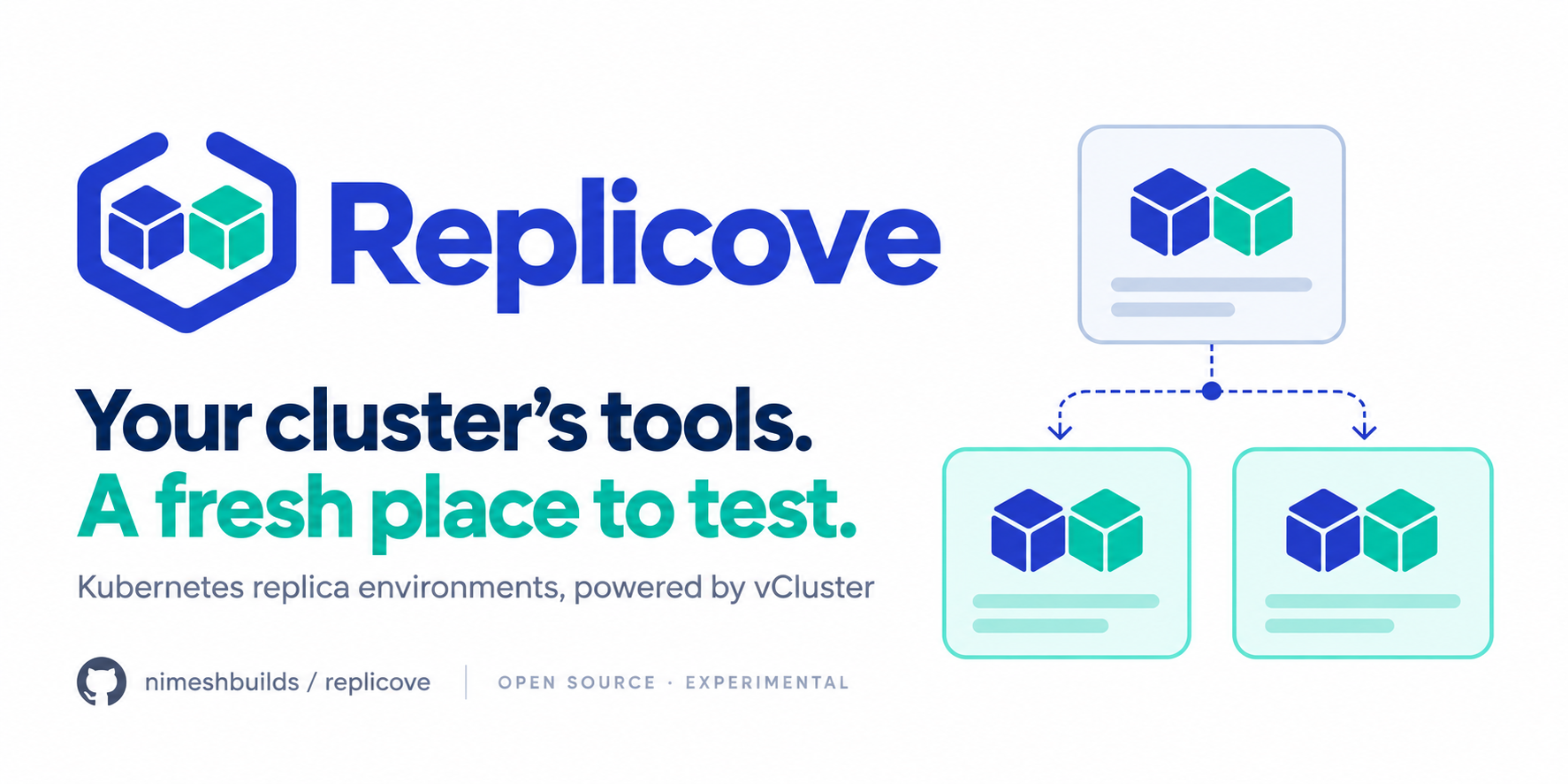
Keep clear space around the mark. Use the supplied assets when describing Replicove; do not imply affiliation or endorsement for another project. Repository assets are provided under the repository license; third-party names and marks belong to their respective owners. The name research is a preliminary collision check, not trademark clearance.
Describe the project accurately
Short description:
Replicove is an experimental open-source Kubernetes operator for disposable integration-test environments, powered by vCluster.
Long description:
Replicove provides a declarative workflow to recreate selected Kubernetes operators and configuration in disposable virtual clusters. It adds source selection, replication plans, access, and lifecycle management around vCluster. The default branch contains an experimental portable alpha, tested in disposable Kubernetes clusters. Cloud identity, data restoration, and production qualification remain roadmap work.
Link to project status whenever describing compatibility or availability. Avoid “exact clone of any cluster,” production-readiness claims, unverified cloud support, or claims that TTL guarantees deletion of all external data.
Maintain the public repository
Keep the repository description, topics, README introduction, and status page aligned. Use specific terms naturally: Kubernetes, virtual clusters, vCluster, integration testing, operators, and ephemeral environments. GitHub controls search indexing; metadata and clear documentation improve discoverability but cannot guarantee rankings or stars.
When changing the social image, commit it here and upload it in Settings → General → Social preview. GitHub recommends a 2:1 image, at least 640×320 pixels. Check the rendered README and a repository link preview after publishing. Keep descriptions readable instead of adding repeated keyword lists.
The repository was renamed from cluster-replica to replicove. The original Go module, prototype binary, and CRD identifiers remain compatible; update public links to the canonical repository URL. Do not create a new repository at the old path, which would interfere with GitHub's redirect.